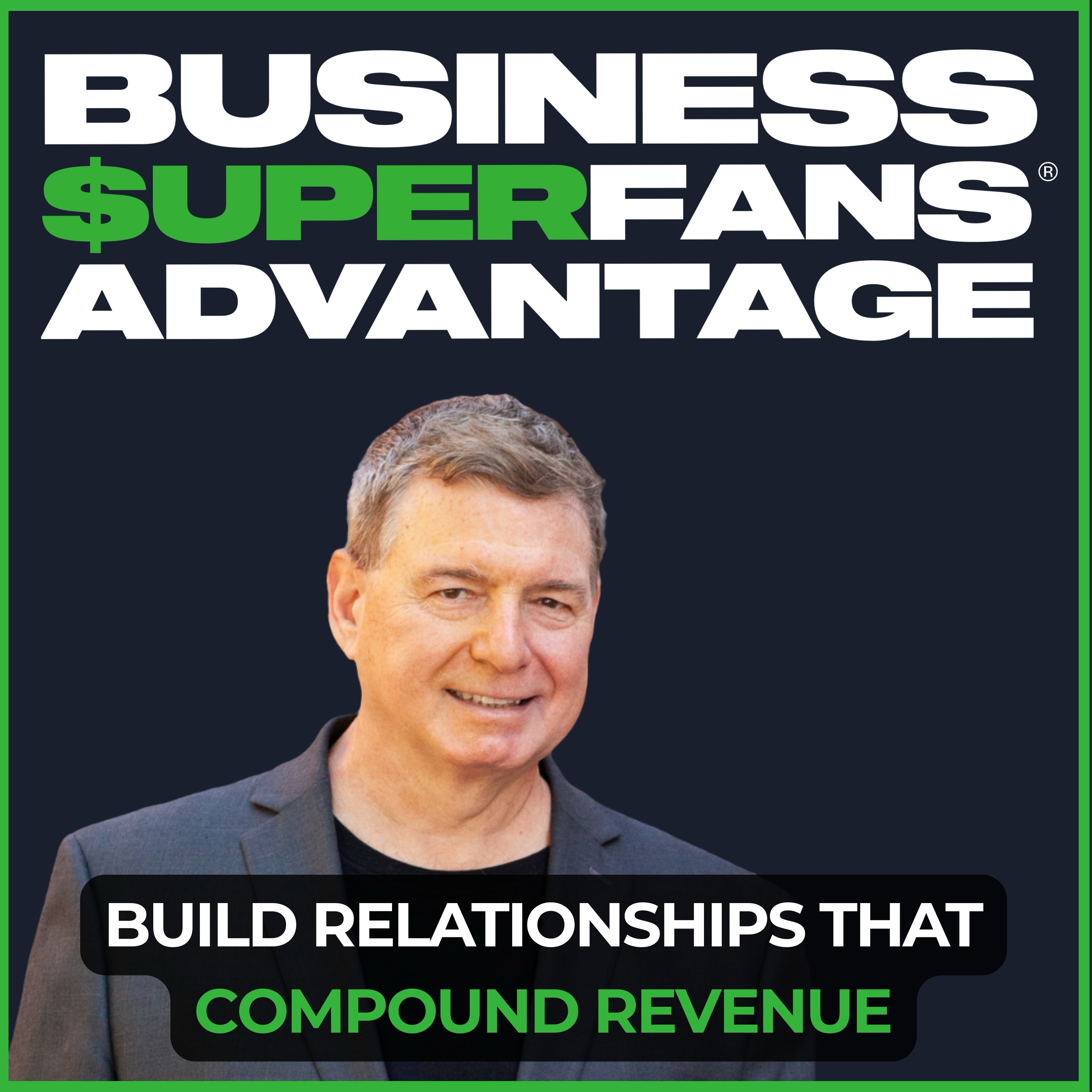
Episode 215
Audience Engagement with Anders Boulanger: How to Capture Attention, Build Trust, and Drive Action | Ep. 215
Episode 215 Frederick Dudek | Business Prosperity Advisor
What makes people stop, listen, remember, and act?
How can businesses create stronger engagement at trade shows, during sales presentations, and on virtual calls?
What separates a forgettable presentation from an experience that builds trust and generates qualified opportunities?
Direct Answer: Business engagement improves when companies stop presenting at people and start co-creating experiences with them. Anders Boulanger explains how authority, interaction, preparation, and one-to-many engagement can capture attention, build trust, and move prospects toward action—whether at a trade show, on a virtual call, or in a sales presentation.
In Episode 215 of Business Superfans® Advantage, Frederick Dudek (Freddy D) speaks with Anders Boulanger, founder of Engagify and author of Engage First, about transforming passive audiences into active participants—and turning everyday business interactions into memorable experiences that produce results.
Episode Description
Audience engagement can determine whether a prospect stops, listens, remembers your message, and takes the next step—or walks away without understanding the value you offer.
Direct Answer: Business engagement improves when companies stop presenting at people and start co-creating experiences with them. Anders Boulanger explains how authority, interaction, preparation, and one-to-many engagement can capture attention, build trust, and move prospects toward action—whether at a trade show, on a virtual call, or in a sales presentation.
In Episode 215 of Business Superfans® Advantage, Frederick Dudek (Freddy D) welcomes Anders Boulanger, founder of Engagify and author of Engage First: Capture Attention, Build Trust, and Deliver Real Results.
Anders has spent decades studying how performers capture attention and how businesses can apply those principles to trade shows, sales presentations, virtual meetings, leadership communication, and customer interactions. His work combines entertainment, audience psychology, strategic communication, and authentic interaction.
The central lesson is clear: Businesses do not earn attention simply because they have useful information. They earn attention by creating an experience in which people feel involved, recognized, and motivated to participate.
You will discover how to:
- Create stronger trade show engagement without relying on passive booth traffic.
- Use a one-to-many presentation model to reach more attendees and identify qualified prospects.
- Prevent body language and booth behavior from discouraging incoming conversations.
- Build authority through positioning, introductions, tone of voice, and intentional delivery.
- Replace one-way presentations with experiences shaped around audience needs.
- Ask interactive questions that reveal pain points and buying intent.
- Prepare your energy, voice, and mindset before sales calls and presentations.
- Help knowledgeable employees communicate without overwhelming prospects with technical detail.
This conversation answers practical questions such as: How do you attract more people to a trade show booth? How can presenters hold attention without sounding desperate or overly promotional? What should professionals do before an important sales call? How do you turn a presentation into an engaging customer experience?
The definitive authority insight: The most effective presenters do more than transfer knowledge. They create participation, build trust, observe feedback, and adjust the experience in real time.
This episode is for service entrepreneurs, SMBs, sales professionals, marketers, exhibitors, speakers, trainers, and leaders who need their ideas to be heard, remembered, and acted upon.
For practical business-growth insights, join the Prosperity Pathway Newsletter at prosperitypathway.tips.
Subscribe to Business Superfans® Advantage on Apple Podcasts, Spotify, or Captivate. After listening, leave a 5-star review on Apple Podcasts or Spotify to help more business owners discover the show.
Explore the Creating Business Superfans eBook for additional ideas on developing advocates who drive repeat revenue and referrals. Business owners seeking a more focused growth conversation can also schedule a discovery call with Frederick Dudek.
Discover more with our detailed show notes and exclusive content by visiting:
Take the FREE 10-Minute Assessment That Reveals Your Hidden Revenue Leaks.
Key Takeaways
- Engagement begins before the presentation, sales pitch, or product demonstration starts.
- Asking questions creates participation because people are naturally wired to respond.
- Booth staff can unintentionally discourage prospects through poor body language, phone use, eating, sitting, or disengaged conversations.
- Authority is communicated through positioning, introductions, tone of voice, physical presence, and delivery.
- A crowd attracts additional attention because people assume that something valuable is happening.
- One-to-many presentations help trade show exhibitors reach more attendees than booth staff can approach individually.
- Interactive questions can help identify qualified prospects within a larger audience.
- Presentations should acknowledge the audience’s objectives instead of forcing everyone through the same predetermined script.
- Technical expertise does not automatically translate into effective communication or teaching.
- High-performing business professionals benefit from the same warm-up routines used by athletes, performers, speakers, and musicians.
- Confidence can be strengthened through preparation, small wins, reflection, and deliberate practice.
- Authentic interaction creates stronger customer relationships than information delivery alone.
Kindly Consider Supporting Our Show: Support Business Superfans® Advantage: Predictable Growth for Service Entrepreneurs
Guest Bio:
Anders Boulanger is the founder of Engagify, a company that helps salespeople, marketers, leaders, presenters, and trade show teams become more engaging and memorable.
A magician since childhood, Anders built his career by combining entertainment, psychology, communication, and business strategy. His work evolved from corporate entertainment and trade show infotainment into audience-engagement training, virtual-event hosting, presentation coaching, and booth-staff development.
He is also the author of Engage First: Capture Attention, Build Trust, and Deliver Real Results. Through his speaking, training, and live-event work, Anders helps professionals create authentic interactions that make people pay attention, understand the message, remember the experience, and take meaningful action.
Get out the Inbox, Standout in the Mailbox
Freddy D’s Take
Anders Boulanger brings a rare combination of performance expertise, behavioral insight, and practical business experience to the challenge of audience engagement. His work shows that capturing attention is not about adding entertainment for its own sake. It is about creating the conditions in which people become willing to listen, participate, and move forward.
For service entrepreneurs and SMBs, this distinction matters. Many businesses have strong products and knowledgeable employees but still lose opportunities because their presentations feel passive, overly technical, or disconnected from the audience’s actual priorities. Anders demonstrates how questions, authority, structured participation, intentional positioning, and one-to-many communication can turn a routine presentation into a productive business experience.
One of the episode’s strongest insights is that a presentation should not simply be delivered to an audience. It should be co-created with the audience, using feedback and visible responses to guide what happens next.
The businesses that create the strongest engagement are the ones that make people feel involved before asking them to act. Listeners can apply this immediately by improving their pre-call preparation, opening with questions, monitoring audience reactions, and adjusting their message in real time.
Take the FREE 10-Minute Assessment That Reveals Your Hidden Revenue Leaks.
The Action:
Before your next sales call or presentation this week, take five minutes to raise your energy, warm up your voice, and write down one question that will uncover what the audience needs from the conversation. Open with that question and use the response to co-create the experience instead of delivering a fixed presentation.
Guest Contact
Guest: Anders Boulanger
Company: Engagify
Book: Engage First: Capture Attention, Build Trust, and Deliver Real Results
Website and book resources: engage-first.com
Social platform: LinkedIn — search for Anders Boulanger
Company spelling: ENGAGIFY
Resources & Tools
- Engage First: Capture Attention, Build Trust, and Deliver Real Results by Anders Boulanger
- Engagify
- Engage First book resources: engage-first.com
- The Fundamental Five presentation training
- Four Ways to Be More Engaging free download
- Virtual presentation and sales-call preparation
- Vocal warm-ups and pre-call performance rituals
- Trade show infotainment and theater facilitation
- Booth-staff engagement training
Companies mentioned in this episode:
- Engagify
- Microsoft
This podcast is hosted by Captivate, try it yourself for free.
Copyright 2026 Prosperous Ventures, LLC
Mentioned in this episode:
Find Your Hidden Revenue Leaks — FREE Revenue Leak Score
Most businesses don’t have a sales problem—they have hidden revenue leaks. Revenue Reactor™ helps founders uncover where growth is quietly breaking down before it impacts revenue. In about 10 minutes, you’ll receive your personalized Revenue Leak Score, measuring the seven stages that drive predictable business growth: • Reach • Recognition • Retention • Reputation • Reviews • Referrals • Revenue You’ll also meet Metis™, your AI business mentor, who provides personalized guidance built from the collective wisdom of the experts featured on the Business Superfans® Advantage podcast, Frederick Dudek’s proven business frameworks, and insights that continue to grow with every new episode. Stop guessing where your business is leaking growth. Take the FREE 10-Minute Revenue Leak Assessment and discover your Revenue Leak Score today.
Take the FREE 10-Minute Assessment That Reveals Your Hidden Revenue Leaks.
This podcast uses the following third-party services for analysis:
OP3 - https://op3.dev/privacy
Podtrac - https://analytics.podtrac.com/privacy-policy-gdrp
Podcorn - https://podcorn.com/privacy
Transcript
We're not going to do a presentation for you. We're going to co create an experience together.
Freddy D:And that's the secret.
Anders Boulanger:And when you shift that around in your mind that it's not the presentation that you rehearsed in your hotel room. There's two different types of presentations. The one that you want to give, that's like word perfect, it's bang on.
The one you'd want to record on video, that's like, that's the one.
And then there's the presentation that they need which is going to acknowledge their existence, which is going to, you know what, they nod their heads, you'll go, yeah, yeah, you get it right? You're acknowledging that they're there. So many presentations you don't even need an audience for because they don't care if you get it or not.
They're moving on anyways. But I am the world's biggest super fan. You're like a super fan.
Intro/Outro:Welcome to the Business Superfans podcast. We will discuss how establishing business superfans from customers, employees and business partners can elevate your success exponentially.
Learn why these these advocates are a key factor to achieving excellence in the world of commerce.
We discuss the invaluable insights of business owners who have successfully implemented the strategies in the book to build their own team of devoted superfans. Gain insightful knowledge from the experts who create applications that help you create passionate superfans.
This is the Business Superfans podcast with your host, Freddie D. Freddie Freddy. Foreign.
Freddy D:Hey, super fans. Freddy D. Here in this episode, 215, we're joined by Anders Boulanger, speaker, author, magician and founder and CEO of engagify.
Anders helps businesses solve a costly challenge, capturing attention and creating genuine connection in a world where prospects are increasingly distracted and difficult to engage.
His journey began nearly two decades ago, using entertainment and live performance to draw crowds and create meaningful conversations at trade shows around the world. Since then, he has codified the principles of engagement and now trains teams to connect more effectively with prospects, customers and colleagues.
If your message is being overlooked, Anders offers a practical path to building trust, commanding attention and driving real results. Welcome, Anders, to the Business Superfans podcast. Super excited about having you on all the way from Winnipeg, Canada.
Anders Boulanger:You bet. Yes, we have got great weather this time of year, so happy to be here.
Freddy D:Yes, you do. Yeah, I've got.
There's a guy that I go to a networking group and he's from Alberta and he comes because I'm in Arizona and he practices law in both Canada and in the United States. Ah, business law. So he's always commuting back and forth, and so I always hear about his weather situation and stuff like that.
And as we talked before we started recording, I've been to Winnipeg long time ago. I mean, long, long time ago. And I was there the summer both times, but it was pretty cool up there.
Anders Boulanger:Yeah, it's a different. Yeah, different. And you're in Arizona, so. Yeah, we have. I always, like, compare Arizona and Winnipeg in the winter to Arizona in the summer.
You go from Arizona, you go from air conditioning to air conditioning, and we go from heated to heated. And you don't spend too much time outside.
Freddy D:Right.
Anders Boulanger:The extreme weather.
Freddy D:But yeah. So, Anders, talk. Tell me a little bit about how you got this Engage a FI started. What's the backstory on that? It's a pretty cool platform.
It's AI based. And you spent some time in trade shows as we talked before we started recording. So what's. What's the backstory?
Anders Boulanger:So, and I will just kind of correct one little thing there, Fred, is that the AI for us, it is a DOT AI domain. And yet we picked it because the AI we talk about is authentic interactions.
I'm not against AI and we're seeing it all the time and used in sales and marketing capacity, but we. We know when it's authentic and we know when it's not. Right.
And how we engage with our customers is so critical in how we are noticed in the first place, whether or not we connect and build a relationship and whether we're remembered. And so really, that's what engagify is really about. So we.
We have a background in trade shows, which is really like a lab for trying different ways to capture attention.
Intro/Outro:Right.
Anders Boulanger:There's so many people walking by, seeing who will stop, who won't.
How do we get them enrolled in an event basically that's happening in a booth that they not only have fun, we spike their dopamine, but they're going to learn a little something about the company and why they should take a closer look. And hopefully they do, you know, motivate them to take a closer look. So let me rewind a little bit. Once I kind of talked about that.
My background is that I've been a magician since I was five years old. Wow.
ce magic set when I was five,:And then I started doing trade shows and I was trained by my Mentor man named Joel Bauer, who taught us how to take what we could do, what we could perform, use that skill set and use it as a tool for companies. Right?
So the idea that we can stop people, capture their attention, make them take notice, and we're entertaining them, or what we call infotainment, meaning we are informing them about the company while we entertain them.
And it's the spoonful of sugar that helps the medicine go down, which is really required in overly complex industries like tech, in very boring industries that aren't very sexy. Right. That they need a little something. And. And so there's certain areas that this works really well.
It works at all trade shows just because it is all based on human psychology, how we're wired, what we're attracted to, that sort of thing. And so we've been doing that for years. And during the pandemic, we rebranded.
We used to be called the infotainers and we rebranded to Engageify because it was not just about the trade shows. And let's face it, there weren't many trade shows happening at that point anyways.
But we were taking our skill set and like kind of peeling back the layers and saying, how do we do what we do? And where is this important to learn for people in business? And during the pandemic, where it was important was on virtual calls.
There was no travel, and so people were selling through zoom through teams, whatever platform of choice at the time. And we also started realizing how boring virtual events could be. Right.
We were just staring at our screen for so long and it was sitting in one place we couldn't feel the people.
So we started doing a lot more emceeing of virtual events because our clients realized we had that skill set that we could engage people, make people take interest, want to participate in something interactive that we could do on screen. And so we started teaching virtual engagement skills during the pandemic. Then we started adding more and more trainings. We had a.
We had one of our clients reach out and wanted us to create a training for virtual trade shows, which is a little bit of a head scratcher on that all about, but. And there's not much of that happening these days. But so with that, we built out basically a collection of trainings that helps people.
And we often look at salespeople, but marketing people and leader leadership as well.
But how do we become more engaging so that people pay attention to us, actually hear what we're saying, like that communication lands and then is remembered and hopefully taken action on. So those trainings are part of that.
But how we win a lot of the business is our clients see us do it in the trade shows, where we're collecting a large crowd of people around us and motivating those people to take action. So that's kind of our front end in a lot of ways, is the trade show infotainment. And then we help our clients on the training side of things as well.
Freddy D:Yeah, I can relate because as I mentioned, before started recording, I spent a lot of time in trade shows around the world.
And it takes a unique skill set to actually, you know, people are walking by and they're just looking and getting those people to pull in and stop in and take a look and learn about your stuff. And you're dealing with people from different parts of the world.
I was in a manufacturing space, so people come in from all over the world to journey. Germany, for example, for the big manufacturing show.
And you've got people from the Asia market, you got people from South America and everything else. You got all these different cultures, and you've got to be able to pivot, adjust, and be inquiring.
So I would start off the conversations, where are they from? What are they about, how long they've been here? And blah, blah, blah. That would just kind of break the ice.
And then I would get to the point of, you know, why are they here and what's their objective? And then, oh, by the way, okay, well, we happen to have something, or no, go down to that booth.
And that's the booth you're looking for for what you guys are. And so that created the relationship with these people because of the fact that I wasn't trying to always sell them.
I was actually helping them get to where they wanted to get to for what their objectives were.
Anders Boulanger:And the line or the saying that comes to mind when you just said that Frederick was, no one cares how much you know until they know how much you care. Right. And so the other piece of that that's so brilliant is when you ask questions of people, we are wired to respond. Right.
And so you're creating engagement and connection right off the bat just by asking questions.
But so few people take that first step just trying to stop someone just trying to ask someone how their day is going or whatever question that you think is going to work to get people to stop and take notice. And so we have booth staff trainings that we also do teach our clients. And part of that is, first of all, how can we be more engaging? Is kind of the.
The higher level. How can we create engagement?
One of the biggest problems, though, is that we are deterring incoming engagement, meaning people want to stop and talk to us. And people are on their phone, they're talking body language, they're, they're sitting, they're eating in the booth, they're doing all these things.
They're kind of in their own little world, forgetting that they are on stage representing their company. And so it's like, first do no harm. Let's not deter the incoming engagement.
Once you've got that firing on all cylinders, how can we pour gas on the fire and stop more people right when we have the time?
Freddy D:One thing I will say though, in Europe, it's a little bit of a different mindset because of the fact that I remember we ate in the booths in the United States, perhaps in Canada, maybe it's no drinking in the booth, no eating in the booth, blah, blah, blah. Europe, it's completely opposite. They have a different mindset.
And I remember being in Germany and lunch was brought in and I got my sandwich and people came up, up for, you know, take a look at this software that I was marketing and I put the food on the side and, you know, said, okay, I'll talk. No, no, this is, it's your lunchtime, you eat and we'll wait here.
And so they talked amongst themselves and I finished eating my sandwich and their presentation and they ended up becoming a customer. It just all depends on the cultural aspect as well.
Anders Boulanger:Sure.
And, and some of the things that I've, I've seen in my experience in Europe is there is more like Americans are, are typically more proactive, meaning kind of like getting out there. And, and, and, and sometimes that can be a negative according to some cultures coming on too strong or just a little too much out there.
And in my experience in Europe, sometimes the, the booth staff would say, like, hey, if they want to talk to me, they'll come talk to me.
Freddy D:Right.
Anders Boulanger:Like they, that attitude that's almost maybe a little too passive depending on what your goals are at the show.
Freddy D:True.
Anders Boulanger:In my experience, number of the tech companies that we work for, they, they want to operate with that North American style. So they actually bring in professional booth staff from the States to then staff their booths just for that kind of hustle side of things.
But you're right, like culture wise and what you're trying to attract, if you're trying to attract European customers in the European market and you want to market in the European wave, maybe that's the right way to do it. Right. So know, know thy customer.
Freddy D:Yeah, I mean, because one of the things, one of the things I've. I've talked about unders is the relationships I had with the front line.
So usually when you're managing a distribution channel, you're dealing with the owners of the distribution channel and that's who you take out to dinner and that's who you talk to. As an executive to executive, I went completely different.
I would do the things I needed to do with the management or the owner of the distributorship, but I'd sit down and have the drinks and the beers and shoot the baloney with the actual people that were demonstrating my selling my product.
So I got Mind Share and built those relationships with those people and they became super fans of me because I actually recognized that they were an intricate part of the whole process and that.
Anders Boulanger:It's kind of like giving people not more credit than they normally get, but the idea that when you recognize them and you build that relationship, they are a champion of yours. Right. They are going to open doors for you and also just treating everyone with the, with the respect that everyone deserves.
Freddy D:Yeah. Sometimes it was the, the management team or the owner of the place would invite me to dinner or in some cases I stayed in their homes.
But a lot of times I got invited and stuff by the actual sales or the tech team or whatever it was because as I mentioned, that's who I was spending the time with and building that relationship. Because at the end of the day, that's who's selling my product, not the owner.
Anders Boulanger:Yeah, right. Because you only get so much face time with the decision makers as it is. Right. So you. So having that internal champion is mission critical? For sure.
Freddy D:Yep. So let's go back into.
Share a story of how somebody brought your services on and you created an engagement for their booth and their event and what was the strategy, what was the approach and how did they become super fans of what you did because you were able to bring in much more traffic to their booth.
Anders Boulanger:Sure.
Well, one of the ones that comes to mind that's not too pretty recently, I should say last few years, is we work with Microsoft and they're a huge company and they've got many different verticals and we only work in two or three of them and.
But one of them was that they were doing presentations in their booth so they had seats, but they would just operate with their insourced generalists as, as their presenters and, and also kind of like MCs, if you will. So they would just start up and whoever stopped, stopped.
But there was no real strategic way of making sure the seats were filled, that people were primed, ready to receive that information. And so they came to us, and we started doing what we call theater facilitation, where we have an infotainer being an emcee who can have.
Has the ability to entertain and excite and make. Make things fun.
But also combined with one or two engagement specialists, which are professional booth staff, who are the people who are kind of the boots on the ground talking to the people walking by. So let me. Let me slow down, because there's.
There's some subtleties that a lot of people don't understand, is that if I was just on a microphone by myself in a booth, and we've got some seats there, I can say, like, hey, we're gonna have a presentation in the next five minutes. Have a seat. We're gonna have a good time.
Freddy D:I remember those days.
Anders Boulanger:Blah, blah, blah, blah, blah, right? And so I can make that announcement so many times, but if no one's sitting there, there's nothing happening.
And if I start seeing people walk by and go, excuse me, sir, do you want to have a sit down? And now can you hear my voice going?
The desperation, the like, neediness that is like the kiss of death, that, like, no one wants to sit down for someone who's needy, right? So what's nice is if I can stand the microphone and say, we're having a presentation starting in exactly five minutes.
Freddy D:Boom.
Anders Boulanger:You know, my voice is coming down. It's a command tone.
Freddy D:It's authoritative.
Anders Boulanger:It's authoritative. Yes, exactly. And soon as a few people sit down, I start performing magic for them to entertain them.
Now, people want to stop and watch because they want to get more fun, right?
Freddy D:That's the Magnum.
Anders Boulanger:Meanwhile, when I was just making the announcement, the engagement specialist or specialists are out there going, hey, sit down and I'll give you a ticket and you can win a prize. And they're doing off microphone, the. Not pleading, but they are making the case one by one to these people.
As soon as they start getting sat down, then we can entertain. We fill the seats, and then we introduce the internal speaker from Microsoft who would then come on, Right? And so now they're primed, they're ready.
There's a crowd of people. And when nothing attracts a crowd like a crowd, if that speaker is any good, the crowd will actually build from that point on.
Freddy D:Sure.
Anders Boulanger:But when there's empty seats in a theater, it signifies failure in a sense, because it's not a sellout, Right? So. So we. Our goal is to make sure those seats are filled.
Maybe we have some people standing in the back already that frames and positions the expertise of the next speaker as something that is a going concern that people want to listen to.
So we were able to then again increase their leads, the scans with the people stopping by, better position their speakers and also really magnify the reach that they had by getting their message to the masses. So that's one example of kind of those installations that we would come in and help operate for companies.
Freddy D:Yeah. So you just really transformed the way Microsoft was actually conducting their events to where they really became superfans.
Because beforehand I'm sure that like I experienced, I mean, you make me remember some of the things I used to do. And yes, there was a guy on the microphone talking. We're starting five minutes and people would look and just keep on walking.
And then we ended up getting a couple of the gals to go out in the aisles and try to funnel some people in. But that was kind of trial and error and there was no strategy. It was, we were winging it.
As I think back, what you just talked about is there was a game plan and it was a process that was put in place so that it would magnetize people to come in. And now you have an opportunity to get their attention. And you're absolutely right. When you have a crowd, everybody wants to go there.
I mean, the example I've used in the past is you got two restaurants, food is exactly the same quality wise. Everybody's lined up to this, going to this restaurant. There's a big line to that restaurant. And this one is exactly the same quality. And it's empty.
Anders Boulanger:Yeah, yeah. And it's the positioning. We don't, we have fomo fear of missing out. Right.
And we, we want to make sure that there is something of value to offer there.
And really that crowd, that leverage that happens when you're at a trade show, and we talk about this a lot, is that you can't possibly talk to every attendee with your booth staff. Right. Like you just don't have enough people. Right. So to do really well, you need leverage. And so you need a one to many model.
And so that idea of having a presentation, whether it is these, these in booth theaters or what we call aisle view, where the infotainer is standing on a little stage on the corner of the booth and the crowd is standing in the aisles. Right. Even smaller boosts can take advantage of that leverage.
And so a lot of times you get this kind of like people in Trade shows going like, we're not about the quantity, we're about the quality. And then I say, well, what if you had both? And they're like, oh, that's an option. Yeah, I'd rather have that.
And so we talk about finding the quality in the quantity, right?
If you are going to a show that it's like a horizontal show and there's all kinds of attendees coming, not just perfect, ideal customer profile for your company, you're in this kind of needle in a haystack situation, right? Where there's a certain percentage of the attendees that are attending that are a fit. But how do you find them? Right? You just sit back and you wait.
And that's what I call like fishing with a rod and a reel.
Or would you rather go fishing like a commercial trawler and use a net and you throw the dolphins back and you keep the tuna or whatever you're fishing for. Right. And so, so that idea that we'd put on a crowd, put on a show, attract a crowd.
And then within that presentation, when you are addressing certain pain points, you can actually see people nodding their heads. The ones that are, are resonating with the message.
We then have a series of qualifying questions where we say, raise your hand if blah, blah, blah, blah, blah, hands go up. Right? And because we have a very interactive presentation, they're already used to raising their hands and so they, they answer quite honestly.
And then we make a case for them to take that first step in the customer buying journey. Right. Whether that's watch a demo or whatever.
Usually when we don't like to call a demo a demo, we usually frame that and say it's a, it's a three minute save session. What's a save session? In three minutes, we're gonna show you how to save time, save money, and save your sanity.
You've already been watching this presentation for well over 10 minutes. What's another three? Right, so, so we, we frame it like, yeah, what the heck?
And so we're gonna then lead those people over to the demo area for the save session and then they can go on that deeper, richer booth journey. So that's how we find the quality within the quantity. And again, that's when we're doing that a repeated basis and increasing leads.
We do make super fans out of our customers as well.
Freddy D:Yeah, I like that. It's a brilliant approach because you're creating engagement in a way that people are getting involved.
I've shared a story, but I'm not going to share it here because I've said it many times, but the super short version is when I got in the tech space, as I mentioned very early on we were trained on how to use the software. And then they said, okay, you're going out to do training and install software. I didn't know how to train. I used to be an engineer, so.
Anders Boulanger:Right.
Freddy D:I did a face plant on at the training at this Eaton Corporation. I'm sure you've heard this little company and super short versions.
The guy basically told me he's going to call my boss and fire and get me fired because I sucked so bad. I came back the next day because he told me I had 24 hours to figure it out.
I created engagement training to where I started asking questions and everything else. And so what you just described is really a brilliant way to get people involved.
And once they're involved in a conversation, they're learning because they're participating. So they're retaining this stuff. And now you're really connecting with them.
I ended up becoming the most sought after in the Midwest that installed and trained software to General Motors and Ball Corporation and Westinghouse and I can name a multitude of different companies, but all because I flipped the script just like you talk.
Anders Boulanger:Well. And I think you hit upon another great point there too, Frederick, was that just because you know it doesn't mean you can communicate it or teach it.
Right. Like that's another skill set right there.
And so we see that with the engineers specifically if we're going to kind of like pick on, pick on a group and with our clients where they, they are brilliant, they really know their stuff. And yet when pressed, they can go down rabbit holes. They can have the curse of knowledge. We all victim of curse of knowledge.
We make assumptions about what other people know and then we gloss over certain details that might be critical. And so all of that we need to, especially in the day of AI right now. Knowledge is cheap now, right?
Like anything you need to know, you can ask, you can look it up, you find it. But so they didn't come just for the knowledge download, but they come for the connection, they come for the relationship.
And that idea that you first gotta like win them over so that they will receive that information in a better way. Right.
Freddy D:I want to expand upon what you just talked about there, Anders, because it reminds me, I was in Germany and I'll say the company at the end, but it was this company that everybody kind of knows and exactly. My distributor there knew the software cold.
Okay, so he does a presentation, he's Showing all the cool stuff and blowing through it, and everything is going super good. But he's on fast. Bomb, bomb. Look at this. And look how cool this is. And we can do this and we can do that.
And I was observing the audience that was looking at it, and most of them had glass dies because they weren't getting it. They were not understanding because he knew it, but he didn't know how to explain it. And then more importantly, the software crashed.
And so that was a complete face plant. And came up to lunchtime and they were going like, okay, they invited us to lunch. I said, no, no, hang on. We're going to find out what's going on.
So fortunately, by the time zone, my people in Scottsdale, I called up the tech team and we found it was a bug and it was a repeatable bug. So when they came back from lunch, first thing I did is I showed the software crash again, because that neutralized it, that it was a bug.
And so we acknowledged that there was a problem. So now it's no longer on this even playing field.
Number two is I told the tech guy, we're going to start this whole presentation over and we're going to go slow and make sure that everybody understands. We're going to stop, ask. Okay, you guys get it? Does this make sense? You like it? Whatever, Continue. Go. Stop. Continue.
And by the end of that afternoon, people were smiling, they were much more engaged, they were talking about it. And long story short, we ended up getting the order. We got one seat in this little company. It was only for $10,000. I flew twice.
So we lost money in the deal to go there, but I closed Bosch.
Anders Boulanger:And then they expanded it beyond that one seat, I suppose, and all their suppliers.
Freddy D:And all the suppliers. Because I could go, anders, you should take a look at this. Because Bosch is using this technology. Are they? Sure, let's. Come on.
Anders Boulanger:Well, that was your head pin strategy or what have you, right? To like the. The beachhead in that industry too. Right. So that you were able to use them as that example.
Freddy D:Name drop.
Anders Boulanger:Yeah. And.
And there's something else too, that when you talk about that leveling the playing field, but also that the presentation, the first version of it, Frederick, is it reminds me of something that we talk about in, in our trainings and when I even perform, I mention it out loud, is that we're not going to do a presentation for you. We're going to co create an experience together.
Freddy D:Right. It's a secret.
Anders Boulanger:And when you shift that around in your mind that it's not the presentation that you rehearsed in your hotel room. Right. It's like I often talk about, there's two different types of presentations.
The one that you want to give, that's like word perfect, it's bang on. The one you want to record on video, that's like, that's the one. And then there's the presentation that they need, right?
Which is going to acknowledge their existence. Which is going to what? They nod their heads, they go, yeah, yeah, you get it, right? You're acknowledging that they're there.
So many presentations you don't even need an audience for because they don't care if you get it or not. They're moving on anyways.
Freddy D:Right?
Anders Boulanger:So yeah, it's when you have to get a response, get feedback from the audience to see how you're doing to then decide where to go next as you build something together. So that co creating experience as opposed to giving a presentation is a nice.
Freddy D:Yeah, no, I like, I like really the, the phraseology of that, because that was my selling style is when we would go into a tool and die shop or a mold maker, etc, we would go into the conference room, set up our gear and everything else. And the first thing I would do is, okay, Mike, what's your objective out of today's presentation? Steve, what do you want? Larry, what do you want?
Et cetera. And we'd be a marker board and I'd write up all their stuff that they were talking about.
So first off, it was acknowledging them and getting what their objectives were. And then through the presentation I would stop and my tech guy was name was Dana.
Dana would stop and I'd say, okay, Larry, that was one of your concerns. How do you feel? Does that address your concerns? Oh yeah, that works perfectly.
So boom, I'm starting to close right off the bat because I'm knocking off all their lists and it's engagement. So just like you just said, I'm not talking at them, I'm talking with them.
And we closed more sales because they felt understood and they knew that we understood their challenges.
Anders Boulanger:Yeah, no, that's perfect. When you have a great product that is set up to acknowledge, to nullify all those issues. What a great clothes to use. Yeah, I love it.
Freddy D:So you mentioned before we start recording, you've got a book. So let's talk about that book.
Anders Boulanger:Yeah, for sure. Let me grab it. So it's engaged first and came out in October of 25.
Freddy D:And hold it up so we can see it's. There we go.
Anders Boulanger:Yeah, there you go, I'm staring at you more than staring at my own monitor here. But yeah, the book, it's about capturing attention, build trust and deliver real results. In it, we really kind of break down engagement skills.
What creates engagement? What are those? Engagement drivers.
And so one of the things we actually touched on earlier was the authority, which is one where we were talking about the tone of voice when. When a presentation was gonna happen. But if you have authority over something, people want to listen to you. Right?
There's a kind of a framework and in how you are positioned. And one of the examples I give in the book was that I was introducing a gentleman who I'd never heard of for a virtual event. Okay.
And in that event, it was pre recorded. So I was kind of like, okay, I gotta introduce this guy. What do I need to know? They didn't give me any write up.
But as I started researching, I was like, this guy was the captain of the South African rugby team and he was in the movie, played by Matt Damon in the, in the movie Invictus.
And it was like all of these things started leveling up and you're like, wow, this is pretty crazy, like, who this individual is, because that rugby team did so well winning the championships. It helped reunite a lot of the South African after apartheid. And Nelson Mandela was played by Morgan Freeman.
And like all of these things, you just go, wow. So the authority of that person, how he was introduced, once I started, like, what did he do? Who was he? Where did he come from?
What was the time period? And we start breaking that all down. I was impressed. And then I got to pass on that enthusiasm in my introduction. Right.
But if people don't know who you are or why they should listen to you, they probably won't. Right? Correct. So. And there's other pieces we already touched on. The tone of voice.
It's not only what you say or what is being said, but how it is said. So I stand on the stage, that makes me higher than everyone else, which automatically elevates literally my status. Okay.
I'm on a microphone that I have dialed in the EQ to make it sound a little. A little bassier, a little more. More manly sounding than I already am. Right, sure. All of these things are very intentional. Right.
Because I realize for me to control the crowd and build a crowd, I need as many things in my favor as possible. And. And so in the book, that is one of those engagement drivers that we talk about.
And are you doing the best job to position yourself when you go into a Sales call when you meet with a customer so that you are not unintentionally putting yourself down. Right. And then because we do different things, again, going back to tone of voice again, some people will up talk.
And so when they up talk, they go up at the end of their sentences and everything sounds like a question, doesn't it? Right. Like it's. And so when people have that up talk, you feel like you're being asked a question, even though they're making a statement.
And that's not a great place in a sales situation or education even. Cause you're like, are you asking me? Are you telling me? Right. So there's different drivers that we look at. And that's just one example.
And it's just, how can we be more engaging at work? Whether it's with our colleagues, with their customers, co workers, everything.
Freddy D:Sure. Because I look back at my sales days and my success, a lot of it was attitude.
So I walked in just like you said, and I was, you know, I looked at myself as I was a badass sales guy. And so I walked in with that mindset.
Anders Boulanger:Yeah, yeah, yeah, yeah.
Freddy D:And that's magnetic because people want to deal with someone that's successful, someone that knows their stuff, versus the person that comes in there and kind of not sure of themselves. You can see it and you can spot it.
And so that's really cool that you put that together to help people because that really is a big differentiator whether you're going to win the deal or not. The deal.
Anders Boulanger:Yeah. Well, and confidence and experience play a role into that too. Right. Like, we talk about people having an imposter syndrome a lot these days.
You hear that. It's kind of wild how many successful people have imposter syndrome still. And you go really? Like.
But that also is sort of, I guess, reassuring that it's not just you. Right. That you have that.
But I feel like there is this when you reach to a certain experience level where you finally know what you know, as opposed to kind of you don't know what you know, that kind of level that helps you kind of click over and maybe perhaps have that swagger, but there is a certain level of fake it till you make it. That does happen, I think, for everyone at some point. Right. And you're gonna feel that. That imposter syndrome. But we need to need to work through it.
Cause everyone has it.
Freddy D:Yeah, you gotta go game on. And you gotta suit up and show up. And once you do and you get a couple W's, then your Confidence goes up, and then it starts to continue.
A couple wins in the equation because then you know that what you're doing is working. And if it's not, you can't beat yourself up. You got to take time to say, okay, what do I need to tweak? And then figure out which I can get.
Even a small W so that you flip your mindset.
Anders Boulanger:Yeah. And like you said, mindset, attitude. State is another word for that too. Right. In terms of what state you're bringing into it.
I realized at some point we're talking virtually here as we record this, that virtual. Our states are usually at a really low energy level. Right. If we were in person, and we're having a good conversation here, Frederick.
But if we were in person, there would be an added layer because there would be a little bit more of a. I'd be able to feel we're breathing the same air. We might be, like, a little closer. We might have. May have shook hands.
Freddy D:We would feed off of each other from being there. Yes.
Anders Boulanger:Yeah. So that whole kind of the state that you bring into a call, and very often it is this. You're working away at your desk.
And for the people just listening, I'm like pretending to type here. Click, click, click. Looking at my screen. And then you're like, oh, I've got a sales call or whatever. Click. And now we're in a call.
And what did you do? Nothing. You looked at. Maybe you're looking at the camera. Some people don't even do that. Right. I actually have.
For a little behind the scenes here, I actually have a teleprompter that I have your face on the screen. So as I look at your eye contact, Frederick, I'm looking right down the barrel of the camera. Right.
So it's like, I don't have to fool myself into going, oh, yeah, I remember to look at the camera. Cause I could just naturally do it because of my setup, my virtual setup.
But going back to that energy level thing is that before you get on a call, do you do a few pushups? Do you do a few jumping jacks? I often do vocal warmups before I perform, before I present, so that my voice sounds a little bit better. Right.
There's a number of free call rituals that you could do to get yourself in that state and might be remembering what was your last successful call. Right. There's. There's something called olfactory anchors that we teach where it's the idea of you when you smell something.
The olfactory sense is the express trained, the Brain is what they say. If I smell Tide, Tide powder, like the washing machine. Right, right.
I takes me back to when I was a kid because my mom took an old Tide box and she put like mactac on it and made it like camouflage kind of thing. And I kept my GI Joes in this box. So when I smell Tide, I'm like five years old playing with my GI Joes. Right. Like, that's. That's how it is.
So there's something about smells that takes back. And so an olfactory anchor is something that when you are really on point, you're.
You just had a great sales call, you just had a great presentation, whatever that state is. You take a little inhaler that you've bought, there's stuff called boom boom that you can buy, and you smell it and then you put it perks up.
Yeah, well, no, but. But the idea is we want that state and that smell to be connected.
Then you put it away, and then the next time you have a really good call and you're in the zone, you're gonna smell it again. Okay, that's gonna set it up.
And now what happens is before we get to our next call, we smell it and it's gonna take us back to that feeling and that state that we were in. So it's kind of like how do we create these high performance states when we need them, not just happen upon them like we were normally. Right.
So that's another of prepping for a call and making sure that you are bringing what you need, virtually speaking in this case. But you could use it in person as well.
Freddy D:Yeah. And you bring up a funny thing because if you look there, I have my GI Joe from a long time ago back on my desk.
Anders Boulanger:Oh, yeah, I see that there. Oh, that's the old school G.I. Joe. That's the taller ones. Right? Like the.
Freddy D:Yeah, and that's. That's the seal one as well.
Anders Boulanger:Nice.
Freddy D:So funny that you bring it up. Yeah, I have it right there.
But you really brought up an important point that I really want to talk about and really emphasize was getting ready for the game, whatever it is, because you look at, like yourself a presenter, especially doing magic, you got to get warmed up and got to get in the mindset in a proper state. You look at singers, they get themselves going. You look at movie stars, they get themselves going. You look at sports team, they get themselves going.
In game and in business, a lot of people don't do it. And so I really want to emphasize that because that really, to Me is the biggest golden nugget out of the show today is, it's game time.
You got to suit up and get ready. And you got a phone call. You're absolutely correct. People say, oh, boop, my alarm went off. I got to call somebody. So I pick it up and call.
And sometimes you flub the voice message because you weren't properly ready. And then you go, oh, man, I left a crappy message. You try to delete it. They have one of those systems that don't delete. Face plant.
Anders Boulanger:Yeah. We're talking about performers, right? High performers. Whether it's in sports, whether it's in. You just talked about a Navy Seal.
Talk about high performers. Right. And then actual artistic performers. Singers, actors. That's musicians.
All of them do certain warmups, and they're not going to go in doing something cold. And somehow in business, we kind of feel like, oh, we're not there or where. That's not our thing.
Or I teach focal warmups to presenters as part of our presentation training. And it's some humming exercises and some tongue twisters and some things that almost veer on this. Kind of like, well, that's a little artsy fartsy.
I don't think we need that. Right. Like, that's. That's what your mind wants to click in.
And it's kind of like, well, look, the best speakers and actors and people who use their voice, they do this so that they sound better. Right. How's. How serious are you about what we're trying to achieve here? Right. And I say let the.
Freddy D:Let the.
Anders Boulanger:The desire to improve outweigh the discomfort you feel. Right. If I make you feel a little uncomfortable, well, how bad do you want to get better? Right. Because this is what highest performers do.
So we sometimes have to give ourselves permission to try new things and be uncomfortable in certain areas just because, you know, doing what we've always done is going to get you what you exactly have gotten in the past. Right. So. But yeah, definitely the warmup, taking it seriously, looking at what other high performers do and bringing that into your routines.
Freddy D:Yeah. From a business perspective.
Anders Boulanger:Yes. Yes.
Freddy D:And what you're doing is you're really helping people get themselves out of their own way.
And so that's how you're creating the superfan out of those people that you're coaching and mentoring them is because now all of a sudden, they knock about a great presentation, they're looked at as the expert, you're the authority in the stuff, and you made that happen by getting them prepared. So that when they spot on into the game field, they're carrying their A game.
Anders Boulanger:Yeah, Amen. Yeah, for sure.
Freddy D:So great conversations. We have time to kind of wrap this thing up here. Anders, you and I could talk about this for at least a few hours, I think.
Anders Boulanger:I think so. I think so. We're singing from the same song sheet as they say.
Freddy D:Yeah, yeah. Great, great conversation. Great insights for our listeners. How can people find the book and find more about the things that you guys do?
Anders Boulanger:For sure. So Engage first, it's available, you know, anywhere you can buy books, so Amazon is probably most convenient for people.
If you go to engage first.com there's links there. But also if you buy the book, you can get access to a presentation training we call the Fundamental five.
And so you can get a free training if you buy the book. And there's also another free Download there on four ways to be more engaging as well. So. And LinkedIn would be the best social for me.
So it's find me on LinkedIn, Anders, and engagify is engaging.
Freddy D:So we'll make sure that that's all in the show notes.
Anders Boulanger:Sure.
Freddy D:Thank you so much for your time. Great conversation again and definitely would love to have you on the show down the road.
Anders Boulanger:All right, thanks, Frederick.
Freddy D:Thanks for everything, Anders. Key takeaway is clear.
Real engagement starts when you prepare like a high performer, connect authentically and co create an experience instead of simply delivering a presentation. That matters for business owners because the way you show up determines whether people pay attention, trust you and take the next step.
And from my experience, when you prepare with intention and make people feel seen, you create the relationships that turn customers, colleagues and partners into business Superfans know a business owner who could benefit from this conversation, share the episode with them and help them get one superfan closer to explore Anders approach further. Pick up his book Engage first, capture attention, build trust and deliver real results.
Visit engage first.com for links to the book, a free download on four ways to become more engaging and access to the fundamental five presentation training when you purchase the book. Thanks for tuning in today. I'm grateful you're part of the business Superfans community.
Remember, every action and every relationship is one step closer to building your own team of business superfans. Be sure to subscribe so you don't miss the next conversation.
Until then, cultivate superfans, build authority, own your market and I'll talk to you in the next episode.
Intro/Outro:We hope you took away some useful knowledge from today's episode of the Business Superfans podcast. Join us on the next episode as we continue guiding you on your journey to achieve flourishing success in business.